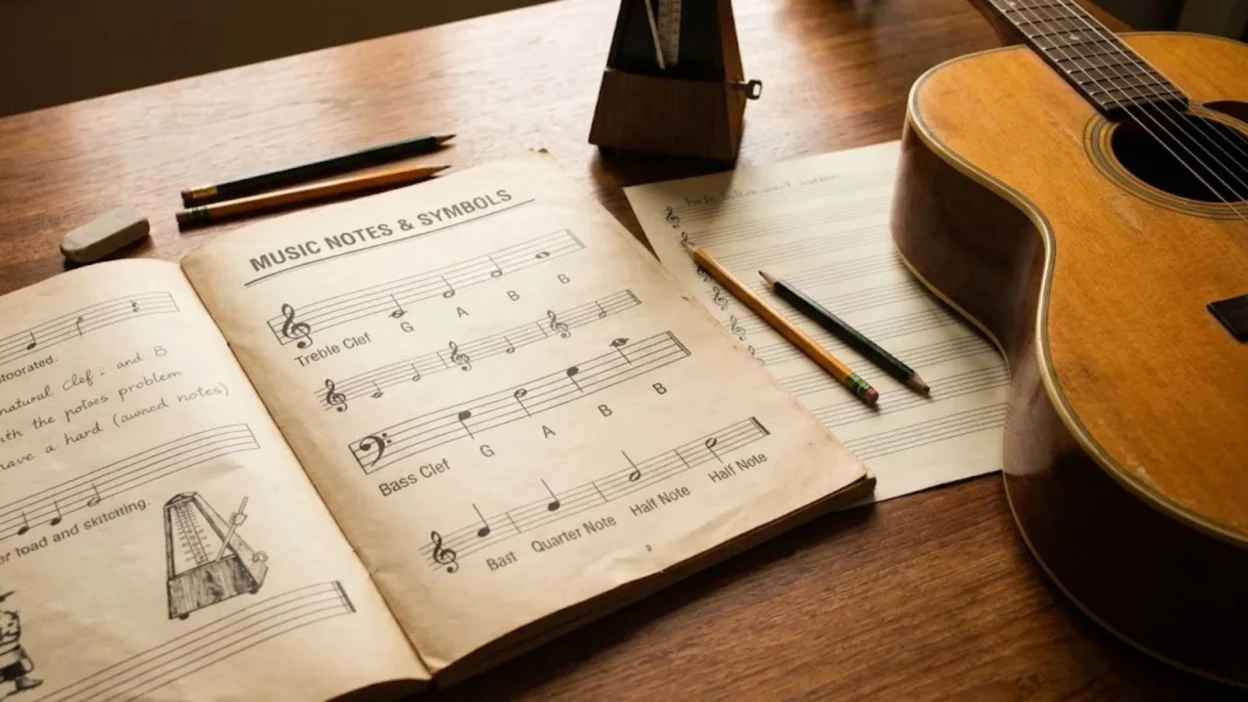
Music is a beautiful language, but understanding its notes and symbols can feel confusing when you are just getting started. Whether you are learning piano, guitar, singing, reading sheet music, or exploring music theory, knowing the correct music notes names makes everything easier. Every note has its own name, position, sound, and purpose, helping musicians understand how melodies and rhythms work together.
Imagine looking at a piano keyboard for the first time. You see white and black keys, but how do you know which one is C, D, E, or another musical note? The same confusion can happen when reading sheet music or learning about musical symbols. That is why learning the basics is so important.
The good news is that musical notes follow a simple and memorable system. Once you understand the seven basic note names, their variations, and how they appear on a musical staff, you can build a strong foundation for almost any instrument.
In this guide, you will discover the main music note names, their meanings, note symbols, piano note names, rhythmic values, and different categories of musical notes. You will also find helpful tips, common mistakes to avoid, and answers to frequently asked questions.
Basic Music Notes Names
The musical alphabet contains seven basic note names. These notes repeat in different octaves, forming the foundation of Western music.
Here are the seven primary music notes names every beginner should learn:
- C
- D
- E
- F
- G
- A
- B
After B, the sequence starts again with C in the next octave. These seven notes are used in piano music, guitar music, vocal exercises, and countless other musical styles.
Music Notes Names with Solfege
Solfege is another popular way to identify musical notes, especially in singing and music education.
- Do
- Re
- Mi
- Fa
- Sol
- La
- Ti
- Do
Musical Notes with Sharps and Flats
Notes can also have sharp or flat variations. These symbols change a note’s pitch.
- C Sharp (C#)
- D Sharp (D#)
- E Sharp (E#)
- F Sharp (F#)
- G Sharp (G#)
- A Sharp (A#)
- B Sharp (B#)
- C Flat (Cb)
- D Flat (Db)
- E Flat (Eb)
- F Flat (Fb)
- G Flat (Gb)
- A Flat (Ab)
- B Flat (Bb)
Music Notes Names and Their Meanings
Every musical note represents a particular pitch. Understanding the seven basic notes and their variations helps you read music and recognize melodies more easily.
Here is a quick reference list of common notes and their meanings.
Note
Meaning
C
First note of the musical alphabet
D
Second basic musical note
E
Third basic musical note
F
Fourth basic musical note
G
Fifth basic musical note
A
Sixth basic musical note
B
Seventh basic musical note
C#
C raised by one semitone
D#
D raised by one semitone
Eb
E lowered by one semitone
F#
F raised by one semitone
G#
G raised by one semitone
Bb
B lowered by one semitone
What Are Natural Notes?
Natural notes are the seven basic notes without sharp or flat modifications.
- C Natural
- D Natural
- E Natural
- F Natural
- G Natural
- A Natural
- B Natural
What Are Sharp Notes?
A sharp symbol (#) raises a note’s pitch by one semitone.
- C#
- D#
- E#
- F#
- G#
- A#
- B#
What Are Flat Notes?
A flat symbol (♭) lowers a note’s pitch by one semitone.
- C♭
- D♭
- E♭
- F♭
- G♭
- A♭
- B♭
Different Types of Music Notes Names
Musical notes are not all represented by the same symbols. Some symbols indicate how long a sound should last, while others represent pitches or changes in musical expression.
Learning these categories makes reading sheet music much easier.
Notes Based on Duration
These musical notes indicate how long a sound should be played or sung.
- Whole Note
- Half Note
- Quarter Note
- Eighth Note
- Sixteenth Note
- Thirty-Second Note
- Sixty-Fourth Note
Notes Based on Pitch
These notes identify different pitches in music.
- Natural Notes
- Sharp Notes
- Flat Notes
- Double Sharp Notes
- Double Flat Notes
- Enharmonic Notes
Notes Based on Musical Position
These names describe where notes appear in a musical arrangement.
- Low Notes
- Middle Notes
- High Notes
- Bass Notes
- Treble Notes
- Octave Notes
Notes Used in Musical Scales
Scales organize notes into patterns that musicians use to create melodies and harmonies.
- Major Scale Notes
- Minor Scale Notes
- Chromatic Scale Notes
- Pentatonic Scale Notes
- Blues Scale Notes
- Harmonic Minor Notes
- Melodic Minor Notes
Music Notes Names and Symbols
Musical notation uses different symbols to communicate pitch, duration, silence, and expression. Learning the most common symbols will help you understand written music.
Here are some important musical symbols and their names.
Symbol
Name
♩
Quarter Note
𝅗𝅥
Half Note
𝅝
Whole Note
♪
Eighth Note
♫
Beamed Eighth Notes
♬
Beamed Sixteenth Notes
♯
Sharp
♭
Flat
♮
Natural
𝄪
Double Sharp
𝄫
Double Flat
𝄞
Treble Clef
𝄢
Bass Clef
𝄽
Quarter Rest
𝄼
Half Rest
What Is a Treble Clef?
Client Challenge
scribd.com
The treble clef is one of the most commonly used musical symbols. It identifies the pitch of notes written on the staff and is frequently used for piano right-hand parts, violin, flute, and many vocal arrangements.
Its five lines represent:
- E
- G
- B
- D
- F
The spaces represent:
- F
- A
- C
- E
A popular memory trick for the treble clef lines is Every Good Boy Does Fine.
What Is a Bass Clef?
Bass clef notes, naming lines and spaces, how to draw | Bass clef notes, Drum sheet music, Learn piano
pinterest.com
The bass clef is commonly used for lower-pitched instruments and the left-hand part of piano music.
Its five lines represent:
- G
- B
- D
- F
- A
The spaces represent:
- A
- C
- E
- G
You can remember the bass clef lines with Good Boys Do Fine Always.
Piano Music Notes Names
The piano keyboard is one of the easiest places to learn musical note names because its keys follow a repeating pattern.
Color-coded piano/keyboard (Printable) by Transdisciplinary Teacher
teacherspayteachers.com
A standard piano has white and black keys. The seven white-key names repeat throughout the keyboard, while black keys represent sharp and flat notes.
White Piano Key Names
- C
- D
- E
- F
- G
- A
- B
Black Piano Key Names
- C# / Db
- D# / Eb
- F# / Gb
- G# / Ab
- A# / Bb
Piano Notes in Different Octaves
An octave is the distance between one note and the next note with the same name at twice or half its frequency.
- C1
- C2
- C3
- C4
- C5
- C6
- C7
- C8
The middle C is commonly called C4 in scientific pitch notation, although octave numbering conventions can vary between systems.
How to Choose the Perfect Music Notes Names
Learning musical notes becomes much easier when you follow a clear approach instead of trying to memorize everything at once. Start with the seven basic notes: C, D, E, F, G, A, and B. Practice saying them aloud until you can remember their order without looking at a chart.
Next, choose an instrument that helps you recognize notes visually. A piano keyboard is particularly useful because the repeating groups of black and white keys make note patterns easier to understand. If you are learning guitar, practice identifying notes on individual strings.
Once you feel comfortable, introduce sharps, flats, and octaves. Try reading simple sheet music and identifying each note before playing it. You can also use flashcards, beginner music apps, and short daily exercises.
The most important thing is consistency. Even 10–15 minutes of practice every day can help you recognize musical notes more naturally over time.
Common Mistakes to Avoid When Learning Music Notes
Beginners sometimes make small mistakes that create confusion when learning musical notation. Understanding these problems early can make your progress much smoother.
Here are some common mistakes to watch out for:
- Confusing note names with note durations: C, D, and E identify pitches, while whole, half, and quarter notes describe duration.
- Forgetting the musical alphabet: The basic note sequence always follows C, D, E, F, G, A, and B.
- Mixing up sharps and flats: Sharps raise pitches, while flats lower them.
- Ignoring the clefs: Treble and bass clefs assign different pitches to the same staff positions.
- Learning without practice: Reading charts is helpful, but playing or singing notes builds stronger recognition.
- Memorizing everything at once: Focus on basic notes before moving to more advanced musical concepts.
Extra Value: Easy Ways to Memorize Music Notes Names
You do not need expensive equipment or complicated lessons to remember musical notes. A few simple activities can make learning more enjoyable and effective.
Use musical mnemonics: Remember treble clef lines with Every Good Boy Does Fine and spaces with FACE. For bass clef lines, try Good Boys Do Fine Always.
Practice with a piano keyboard: Find every C key first. Then identify the remaining white keys by moving from left to right.
Listen carefully: Try recognizing whether a melody moves higher, lower, or stays on the same pitch.
Use flashcards: Write a note on one side and its name on the other. Test yourself for a few minutes daily.
Practice simple songs: Choose beginner melodies with familiar notes. Identify the notes before playing them.
Learn through repetition: Short, regular practice sessions are usually more effective than trying to memorize everything in one sitting.
These small habits can help you develop a stronger musical foundation without making the learning process feel overwhelming.
Frequently Asked Questions About Music Notes Names
Here are answers to some common questions beginners ask when learning musical notes and symbols.
What Are the Seven Basic Music Notes Names?
The seven basic music notes names are C, D, E, F, G, A, and B. These notes repeat in different octaves and form the foundation of Western music.
What Are the 12 Musical Notes?
The 12 pitch classes in the standard Western chromatic system are C, C#/Db, D, D#/Eb, E, F, F#/Gb, G, G#/Ab, A, A#/Bb, and B.
What Is the Difference Between a Sharp and a Flat?
A sharp raises a note by one semitone, while a flat lowers it by one semitone. For example, C# and Db usually refer to the same sounding pitch in equal temperament.
What Are the Music Notes on a Piano?
The piano has seven repeating white-key names: C, D, E, F, G, A, and B. Its black keys represent sharp and flat notes.
What Is Middle C in Music?
Middle C is the C note near the center of a standard piano keyboard. It is commonly identified as C4 in scientific pitch notation.
How Many Types of Musical Notes Are There?
Musical notation includes different note values, such as whole, half, quarter, eighth, and sixteenth notes. These symbols represent different durations rather than different pitches.
Conclusion
Understanding music notes names is one of the most important steps toward becoming comfortable with music. The seven basic notes, C, D, E, F, G, A, and B, create the foundation for melodies, chords, scales, and musical compositions. Once you understand sharps, flats, octaves, clefs, and note durations, reading music becomes much less confusing.
Remember that you do not have to learn every musical concept in one day. Start with the basics, practice using a piano keyboard or your favorite instrument, and gradually explore more advanced notation. Use the charts and memorization tricks in this guide whenever you need a quick reminder.
Whether you are a beginner, student, singer, or aspiring musician, consistent practice will help you recognize notes with confidence. Keep learning, enjoy the process, and let music become a natural part of your everyday life.

Freya Sterling is a passionate naming researcher and content writer who specializes in pet names, baby names, and creative naming ideas. She enjoys helping readers discover meaningful, unique, and memorable names through carefully researched and easy-to-read guides.